

Image made using the COMSOL Multiphysics® software.
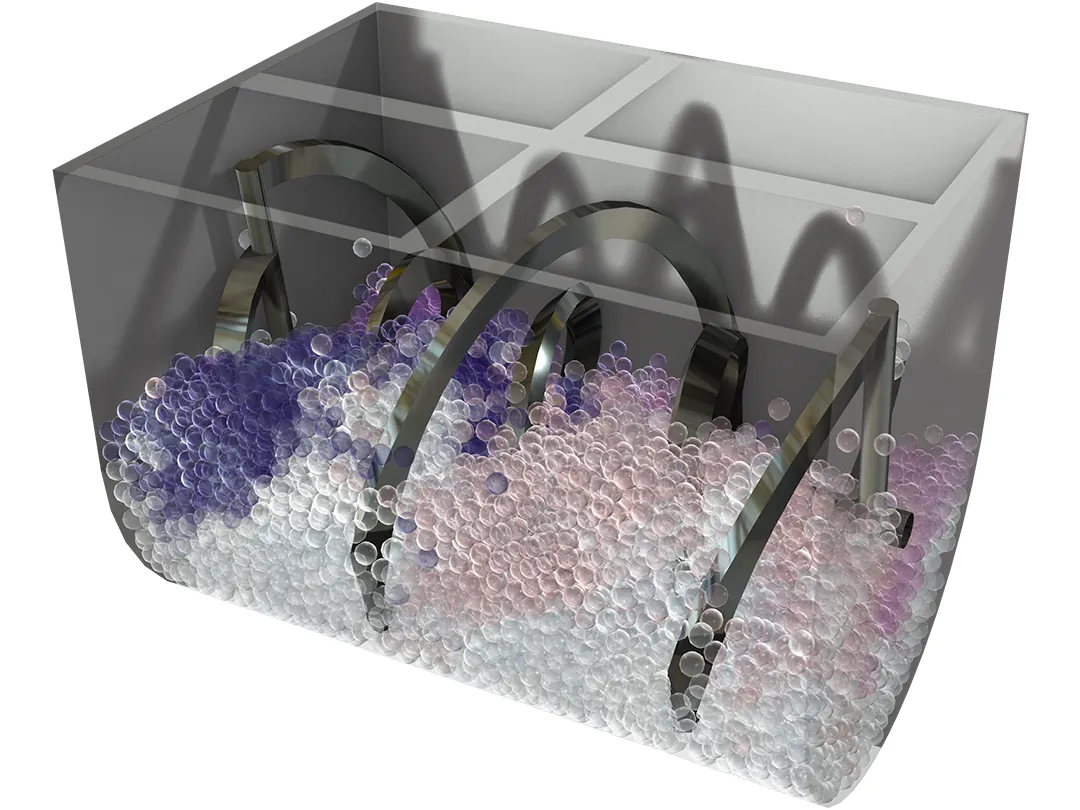
Mixing Grains in a Ribbon Mixer
The Granular Flow Module is used to model the bulk behavior or flow of granular
materials. Granular flow simulations are used to model the behavior of
macroscopic particles, such as sand, grains, powders, or pellets, when subjected to
external forces like gravity, vibration, or shear. Unlike fluids or solids, granular
materials can exhibit both solid-like and fluid-like behavior depending on their
packing, confinement, and stress conditions. Granular flow is important in a
variety of applications including pharmaceuticals, geotechnics, additive
manufacturing, and food processing.
This example uses the Granular Flow interface to model the formation of the grain heap and then its subsequent spreading using a cylindrical roller. The roller has a combined rotational and translational motion. The resulting powder bed is then analyzed to determine its quality based on its packing fraction. Additional packing characteristics such as the distribution of the grain center heights and the coordination numbers are also evaluated.
This model simulates the mixing of two types of grains in a rotating drum with baffles. The effect of the number of baffles on the mixing is demonstrated by varying the number of baffles in the drum. This model also demonstrates how to build and run a model method that evaluates the mixing index from the grain positions.
This model demonstrates the transport of grains using a screw conveyor. The grains enter the conveyor through a chute and are transported over an incline by a rotating screw. This model also demonstrates how to build and run a model method that evaluates the mass flow rate.
A ribbon mixer (sometimes referred to as a ribbon blender) is a mechanical device that is commonly used to mix different types of granular material. Ribbon mixers are widely used across various industries including food processing, pharmaceuticals, chemical industries, agriculture, cosmetics, plastics etc.
This example uses the Granular Flow interface to model the filling of a U-shaped trough with two types of grains, followed by their mixing induced by the rotational motion of the ribbons. This model also shows the use of a Bounding Box feature to avoid scenarios that may adversely affect the performance of the Granular Flow interface. The extent of the overall mixing is quantified by the evaluation of the Kramer mixing index. An additional indicator of the extent of axial mixing is also demonstrated.
This model demonstrates the filtration of grains of three different sizes as they pass through two vibrating sieves of different hole sizes.
This model demonstrates the effect of the hopper design on the resulting flow patterns of the grains exiting the hopper. The flow changes from mass flow to funnel flow when the conical angle of the hopper is increased.


